
The record
One record for everything you collect.
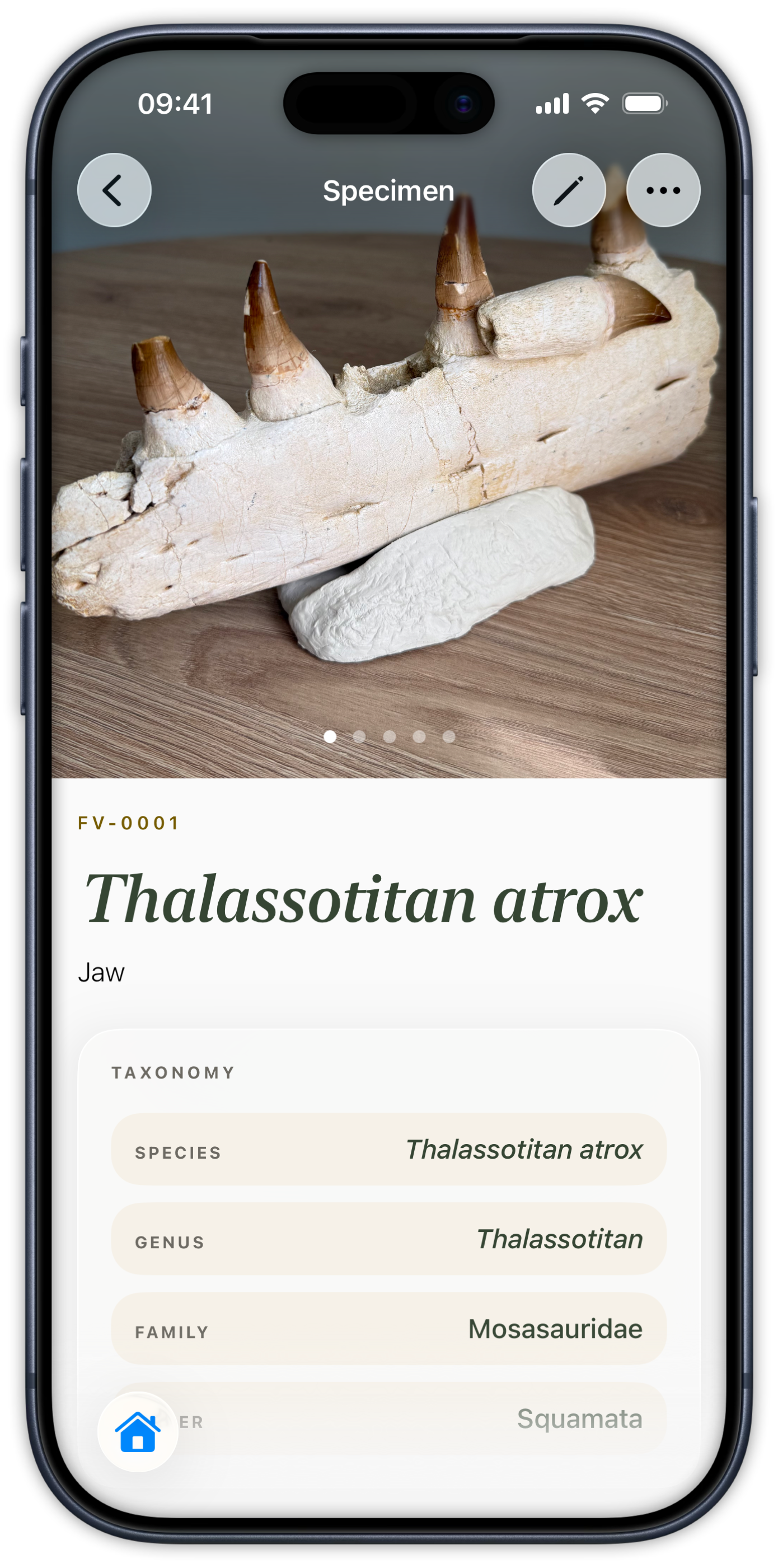
Bought, traded, inherited, or found — every specimen gets the same collector-grade record: identification, geological context, provenance, photos, and value. Four categories, each with its own fields.
 Available on iOS
 Available on Android
Identification
Taxonomy that holds up.
Fossils carry a full taxonomic hierarchy with lookup against the Paleobiology Database, plus the geological time system from Era down to Age. Minerals carry chemical formula, crystal system, and hardness; gemstones add cut, carats, and lab reports; rocks add petrology.
- Paleobiology Database taxonomy lookup
- Era→Period→Epoch→Age, color-coded to the ICS chart
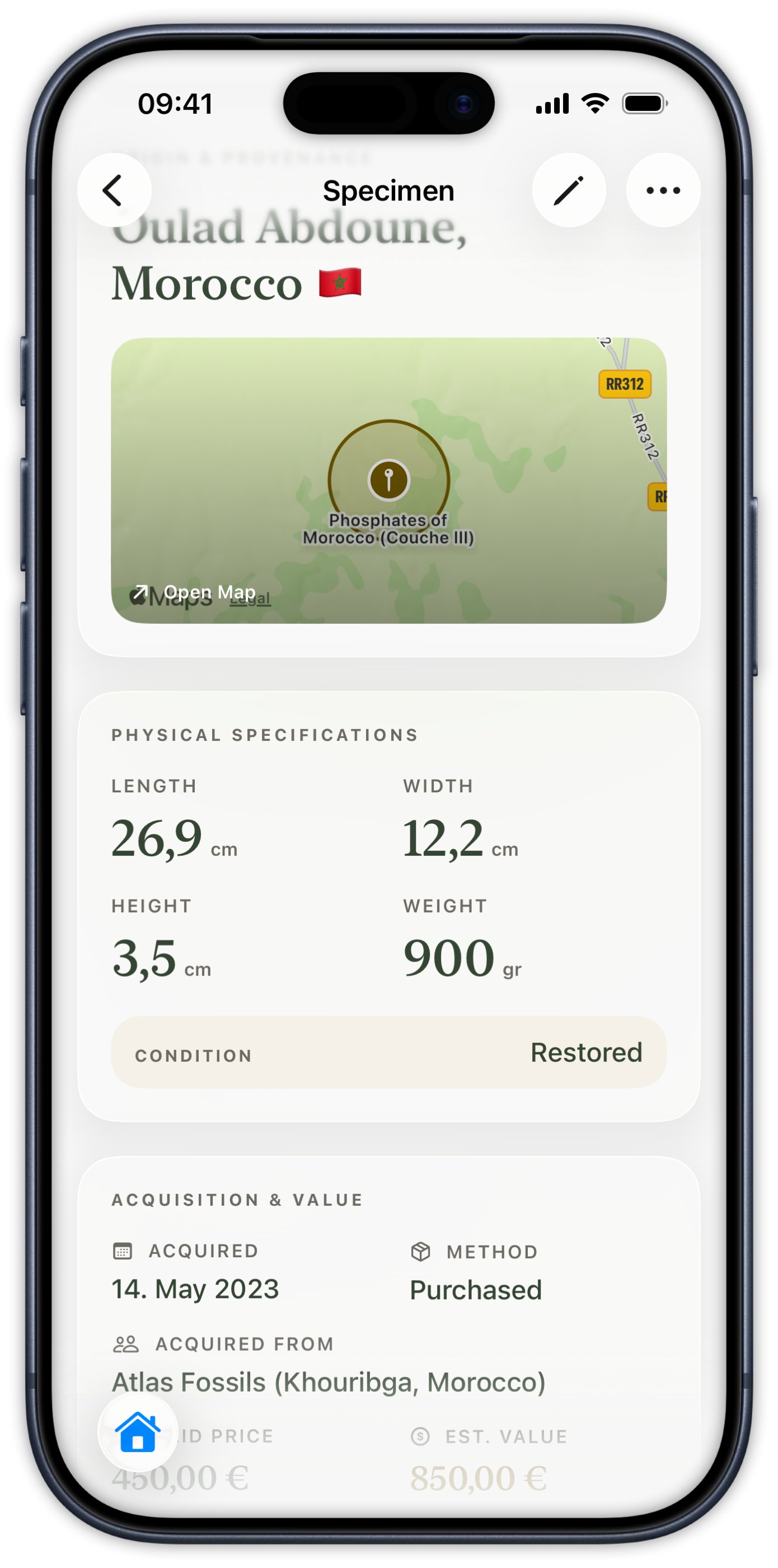
- Formation, locality, and GPS — exact point or approximate area
COLOR-CODED TO THE INTERNATIONAL CHRONOSTRATIGRAPHIC CHART
Provenance & value
The paper trail, kept straight.
Acquisition method and source, partial dates for old finds ('2008' is a valid date), price paid and estimated value in 29 currencies, storage location, and disposition when a piece is sold, traded, or gifted.
- Purchased, traded, inherited, found — just a field
- Price paid & estimated value, per-value currency
- Storage: room, cabinet, drawer · inventory IDs
- Disposition history keeps sold pieces on record
Four categories
Not just fossils.
FossilVault is a specimen vault: fossils, minerals, gemstones, and rocks each get purpose-built fields, and gemstone weights normalize to carats automatically.
- Minerals: formula, crystal system & habit, Mohs, luster, streak
- Gemstones: cut, clarity, carats, natural / lab-grown, lab reports
- Rocks: igneous, sedimentary, metamorphic — texture to protolith
Azurite
Cu₃(CO₃)₂(OH)₂ · Touissit, Morocco
- Mohs
- 3.5
- System
- Monoclinic
- Habit
- Bladed clusters
- Luster
- Vitreous
Ready for your next specimen.
Free to start on iOS and Android.
 Available on iOSAvailable on Android